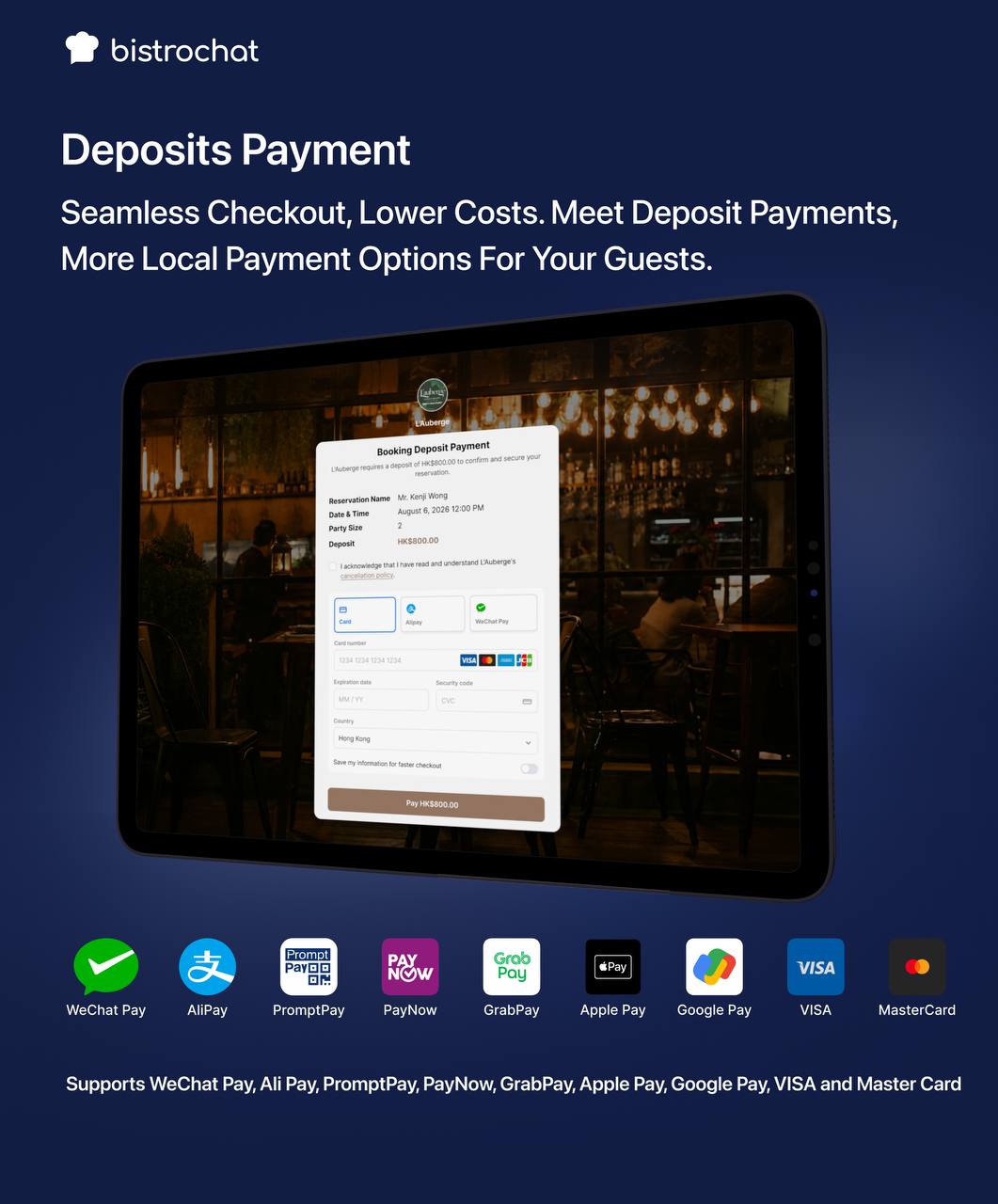
TL;DR: Bistrochat deposit payments now accept WeChat Pay, Alipay, PromptPay, PayNow, GrabPay, Apple Pay, Google Pay, VISA and Mastercard. Your guests pay a booking deposit with the app already on their phone — PromptPay in Thailand, PayNow in Singapore, WeChat Pay and Alipay in Greater China — instead of hunting for a credit card. More deposits paid, fewer no-shows, and local payment rails that usually cost less to process than international cards.
1. A Deposit Only Works If the Guest Can Actually Pay It
Deposits are the most reliable tool a restaurant has against no-shows. But a deposit request is only as strong as the checkout behind it.
Ask a diner in Bangkok for a credit card and you have added friction to a country where PromptPay is how people pay for almost everything. Ask a Singaporean for card details when PayNow is one QR scan away. Ask a guest from Shanghai to type a 16-digit number when WeChat Pay is two taps. Each of those moments is a booking that goes unconfirmed — not because the guest didn't want the table, but because paying was inconvenient.
Payment preference in Asia is local. Your deposit checkout has to be local too.
2. Every Payment Method Bistrochat Now Accepts
| Payment method | Where your guests use it |
|---|---|
| WeChat Pay | Mainland China, Hong Kong, Macau |
| Alipay (incl. AlipayHK) | Mainland China, Hong Kong |
| PromptPay | Thailand |
| PayNow | Singapore |
| GrabPay | Singapore, Malaysia |
| Apple Pay | Worldwide — any guest with a card in their Apple Wallet |
| Google Pay | Worldwide — any guest with a card in Google Wallet |
| VISA | Worldwide |
| Mastercard | Worldwide |
Bistrochat shows each guest the methods that apply to them, so the checkout never looks cluttered — a Thai guest sees PromptPay first, a Hong Kong guest sees WeChat Pay and Alipay.
3. What This Looks Like Market by Market
- Hong Kong — WeChat Pay, AlipayHK, Apple Pay, Google Pay, VISA, Mastercard. The two wallets locals reach for by default, plus full card coverage for visitors.
- Mainland China — WeChat Pay and Alipay, the two rails that carry everyday spending, plus VISA and Mastercard for inbound travellers.
- Macau — WeChat Pay alongside cards, matching how mainland visitors pay when they cross over.
- Singapore — PayNow and GrabPay for residents, Apple Pay, Google Pay and cards for everyone else.
- Thailand — PromptPay, the national QR standard used by tens of millions of people daily, plus cards and mobile wallets for tourists.
- Malaysia — GrabPay for local diners, plus Apple Pay, Google Pay, VISA and Mastercard.
- Philippines, Vietnam, India and everywhere else — Apple Pay, Google Pay, VISA and Mastercard, so a deposit can be requested for any booking, in any market you operate in.
For a restaurant that serves both residents and travellers — which is most restaurants in Hong Kong, Singapore and Bangkok — this matters twice over. The local guest pays in the app they use every day, and the visiting guest still pays by card.
4. Seamless Checkout, Lower Costs
More methods is the visible half. The other half is cost.
Local payment rails such as PromptPay and PayNow are domestic transfer systems, and they typically carry lower processing fees than international card networks. Every deposit that moves from a cross-border card to a local wallet is a deposit that costs your restaurant less to collect — on the same booking, with the same guest.
And because the whole flow lives inside the Bistrochat booking link, there is no separate payment page, no app to download and no account to create. The guest confirms the reservation, sees the deposit amount and your cancellation policy, picks a method, and pays. One screen.
5. Getting Started
Deposit payments are part of Bistrochat's reservation system. You set the deposit amount, decide which bookings require one — peak nights, large parties, tasting menus, private rooms — and Bistrochat handles the checkout, the receipt and the reconciliation.
Ask your Bistrochat contact to enable deposit payments and the local methods for your market.