To get your restaurant recommended by AI assistants, you need three things: a rating above the platform's recommendation threshold (roughly 4.3 stars for ChatGPT), consistent business information across the directories AI systems read, and structured data on your website that machines can extract. Most restaurants fail on all three.
We tested this directly. We asked three different AI models — Kimi K3, DeepSeek and Qwen — a question a diner might genuinely type: "What's the best Italian restaurant in Hong Kong?" All three answered confidently. All three named 8½ Otto e Mezzo Bombana first. Then we asked each model why it picked those names.
The answers were revealing, and they're the most useful starting point any restaurant owner could have.
How do AI assistants actually pick which restaurants to recommend?
AI assistants recommend restaurants using two completely separate mechanisms: what the model absorbed during training (its "memory") and what it retrieves live from the web when it searches. These reward entirely different things, and a tactic that works for one does almost nothing for the other.
When we asked Kimi K3 to explain its own Hong Kong picks, it was unusually candid: "I didn't evaluate these restaurants — I can't taste food or visit anywhere. What actually happened is that certain signals made these names statistically prominent in my training data."
That distinction matters more than anything else in this article. If you only optimise your website, you're playing one of the two games.
What's the difference between what an AI "knows" and what it looks up?
Parametric knowledge is what the model absorbed during training — it can answer without searching, but the information is frozen at training time and skewed toward whatever was written about most. Retrieval is what happens when the assistant searches the live web mid-answer, pulling current pages, listings and reviews.
| What the model already "knows" | What it looks up live | |
|---|---|---|
| Where it comes from | Training data: articles, lists, forums, guides | Live web search, business listings, review sites |
| What wins | Volume and repetition of mentions over years | Accuracy, structure, freshness, ratings |
| How fast you can change it | Slowly — years, via press and citations | Fast — days to weeks |
| Used by | ChatGPT without browsing, offline model answers | Perplexity, Google AI Overviews, ChatGPT with search |
Most restaurants can realistically move the second column this quarter. The first column is a long game — but it isn't hopeless, and we'll cover it below.
How many restaurants does AI actually recommend per query?
AI assistants typically name only three to five restaurants per query, and 83% of restaurant locations never appear in AI-generated recommendations at all — even though 86% have a presence on Google, according to a May 2026 Uberall benchmark report on AI restaurant discovery.
This is the single most important structural fact about AI search: there is no page two. In traditional Google results, ranking eleventh still means you exist — a determined diner can scroll. In an AI answer, being the sixth-best match means you were not mentioned, which is functionally identical to not existing.
The same report found ChatGPT recommends roughly 1.2% of locations, compared with the 35.9% that appear in Google's local pack. Gemini reaches about 11%, Perplexity about 7.4%.
What star rating do you need for AI to recommend your restaurant?
Different AI platforms appear to apply different rating floors. ChatGPT tends to recommend restaurants averaging 4.3 stars or higher, Perplexity's threshold sits near 4.1, and Gemini's around 3.9. A restaurant at 4.0 can still rank perfectly well on Google while falling below the bar ChatGPT uses.
This is a genuinely new failure mode. Under classic local SEO, a 4.0-star restaurant with strong proximity and relevance signals competes fine. Under AI recommendation, that same restaurant can be silently filtered out before the comparison even begins.
The practical implication: review average is no longer a vanity metric, it's an eligibility gate. If you're sitting at 4.1, the gap between you and 4.3 is the gap between appearing in ChatGPT's answer and not existing in it.
How does a restaurant get into an AI model's memory in the first place?
Restaurants enter a model's trained-in knowledge through repetition across many independent sources over time — awards that get cited constantly, placement on "best of" ranking lists, and sustained discussion volume on forums. It's less about any single mention than about the same name appearing in the same context, repeatedly, for years.
When we pushed the models to explain their Hong Kong picks, four specific signals came up:
Award repetition with a legible hook. Kimi named this first: "'First Italian restaurant outside Italy to earn three Michelin stars' is one of the most repeated facts in Hong Kong food writing. That single, legible credential gets cited constantly." The award matters, but so does the fact that it compresses into one repeatable sentence.
Ranking-list placement. The models cited specific list appearances as a boost — one noted a pizzeria surfaced ahead of equally good competitors specifically because a strong placement on a regional "50 Top Pizza" list generated a wave of coverage.
Discussion volume. One model explained a casual pasta bar's prominence directly: it "appears constantly in casual contexts — Reddit threads, forums, expat recommendations… High chatter volume reads as significance."
Longevity compounding. Older restaurants have simply accumulated more text, and food media is self-reinforcing: lists cite previous lists.
Which biases are baked into AI restaurant recommendations?
AI restaurant recommendations carry the biases of their sources: they over-represent English-language food media, Central business districts, hotel restaurants and celebrity-chef venues, while under-representing local-language favourites and recently opened places. Models also lag reality — they can recommend a restaurant for a chef who left years ago.
We didn't have to infer this. Kimi volunteered it: "My picture is heavily shaped by SCMP, Tatler Asia, Time Out Hong Kong, and Michelin — which favour Central locations, hotel restaurants, and celebrity-chef-backed spots. Local favourites beloved in Cantonese-language circles are underrepresented."
It went further, flagging its own recency problem: "Name recognition outlives reality." And it named the upstream distortion plainly: "Restaurants with publicists and hotel marketing budgets get covered more. I'm inheriting that bias, not correcting for it."
Two takeaways for operators. If you're a neighbourhood restaurant without a PR budget, the trained-in game is genuinely stacked — which is exactly why the live-retrieval game below is where your effort pays off fastest. And if you're a well-known restaurant, don't assume the model's picture of you is current.
What makes a restaurant show up in a live AI search answer?
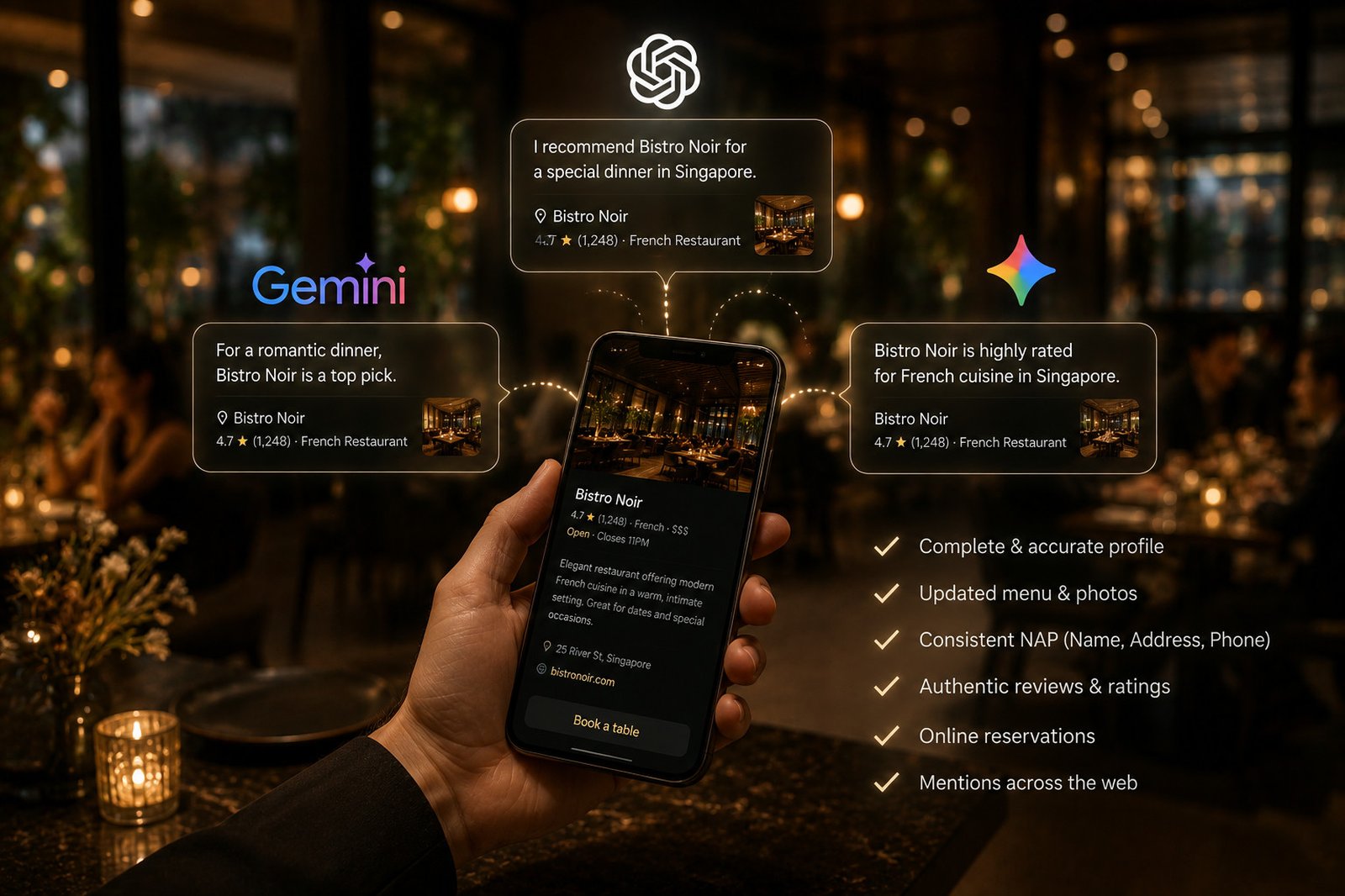
For search-augmented answers, AI systems lean on the same local trust signals as Google's local results: a complete and accurate business profile, consistent name, address and phone number across the web, and recent, genuine reviews. Accuracy and consistency matter more here than marketing spend.
Your Google Business Profile is the foundation. Not merely claimed — complete. Correct categories, current hours including holidays, real photos, an accurate description, and a working link to a booking page.
NAP consistency is the trust layer. Businesses with consistent name-address-phone data across major citation sources are around 40% more likely to appear in Google's local pack, and directory profiles with complete, accurate core fields see substantially more engagement than those with stale details. AI platforms need this consistency to build confidence that all these listings describe one real business.
Review recency and volume, not just average. A 4.5 average built from reviews two years old reads differently from a 4.5 built from a steady flow this month.
Which schema markup does a restaurant need for AI search?
Restaurants should implement Restaurant schema (a subtype of LocalBusiness), plus Menu and FAQPage markup. Restaurant schema inherits every LocalBusiness property and adds restaurant-specific fields including servesCuisine, hasMenu, acceptsReservations, priceRange and openingHoursSpecification.
The fields worth getting right:
name,address,telephone— matching your Google Business Profile exactlyservesCuisine— the literal answer to "best Italian in…" queriespriceRange— how "affordable" and "upscale" queries get filteredopeningHoursSpecification— including holiday exceptionsacceptsReservationsandhasMenu— with a real HTML menu, not a PDF or an imageaggregateRating— where genuinely applicable
One caveat worth stating plainly: schema markup does not guarantee inclusion in an AI answer. It removes ambiguity so a machine can state facts about you confidently — which is a precondition for being recommended, not a purchase of it.
Why does Reddit keep showing up in AI restaurant answers?
Reddit is cited in roughly 40% of LLM citations across ChatGPT, Perplexity, Gemini and Claude, and holds about 21% of Google AI Overviews citations — the single most-cited source there. The reason is structural: Reddit is the largest public archive of specific, experience-based answers to exactly the questions people ask AI.
When someone asks for the best Italian in a city, Reddit has threads where real diners compare specific restaurants with reasons. No restaurant's own marketing page competes with that, because a restaurant's website can only credibly say one restaurant is good.
What this does not mean is that you should astroturf Reddit. Fake recommendations get detected, removed, and can permanently damage a restaurant's reputation. What it does mean:
- Be worth mentioning in threads that already exist about your neighbourhood or cuisine
- If you genuinely participate in local forums, do it transparently as the owner
- Local Facebook groups, dining forums and community boards feed the same signal in markets where Reddit is thin
Which directories matter most in Hong Kong and Southeast Asia?
In Asia, Google Business Profile alone is insufficient. Regional discovery platforms carry substantial weight in both live retrieval and training data: OpenRice across Hong Kong, Macau and Singapore; Dianping for Chinese-speaking diners; the Michelin Guide where applicable; TripAdvisor for visitors; and Chope, Klook and Eatigo for booking-intent queries.
The consistency rule applies across every one of them. The same restaurant name, spelled the same way, at the same address, with the same phone number. Two listings for the same restaurant with different addresses actively damage the entity confidence you're trying to build.
Zomato, Swiggy Dineout and EazyDiner play the equivalent role in India, and are also live booking channels rather than passive listings.
Can you get an AI to recommend your restaurant without a Michelin star?
Yes — but you need a "hook": one specific, repeatable, verifiable claim that food writers and diners can restate in a single sentence. Models surface restaurants attached to compressible facts, not restaurants that are merely good. "Excellent handmade pasta" is not a hook. "The only restaurant in the city making Sardinian fregola in-house" is.
This follows directly from what the models told us. A three-Michelin-star credential works because it collapses into one repeated sentence. You can't award yourself a star, but you can build a claim with the same structural property:
- The oldest continuously operating restaurant of your type in the neighbourhood
- The only place serving a specific regional dish in your city
- A chef with a specific, verifiable pedigree
- A genuine first: first to import a specific ingredient, first zero-waste kitchen in the district
The test is simple: can a journalist restate it in one sentence without hedging? If yes, it can propagate. If it needs a paragraph of context, it won't.
The 12-point AI visibility checklist for restaurants
- Ask ChatGPT, Gemini and Perplexity for the best restaurant in your category and neighbourhood — record whether you appear. This is your baseline.
- Check your review average against the platform thresholds (4.3 / 4.1 / 3.9). If you're below, that's your first priority.
- Complete every field of your Google Business Profile, including holiday hours.
- Audit NAP consistency across every listing you can find, and fix or remove duplicates.
- Claim and complete your regional directory listings — OpenRice, Dianping, TripAdvisor, and the booking platforms your market uses.
- Add Restaurant schema to your site, with
servesCuisine,priceRange,openingHoursSpecificationandacceptsReservations. - Publish your menu as real HTML text, not a PDF or an image. A machine cannot read your menu if it's a photo.
- Add a FAQ page answering the questions diners actually ask, each in 40-60 words directly under the question.
- Set up automated post-visit review requests so review flow is continuous rather than sporadic.
- Respond to reviews, including negative ones — response patterns are a visible quality signal.
- Define your hook and make sure it appears on your own site, in your directory descriptions, and in any press outreach.
- Re-run step 1 quarterly. AI answers shift, and you want to know before your competitors do.
How Bistrochat helps
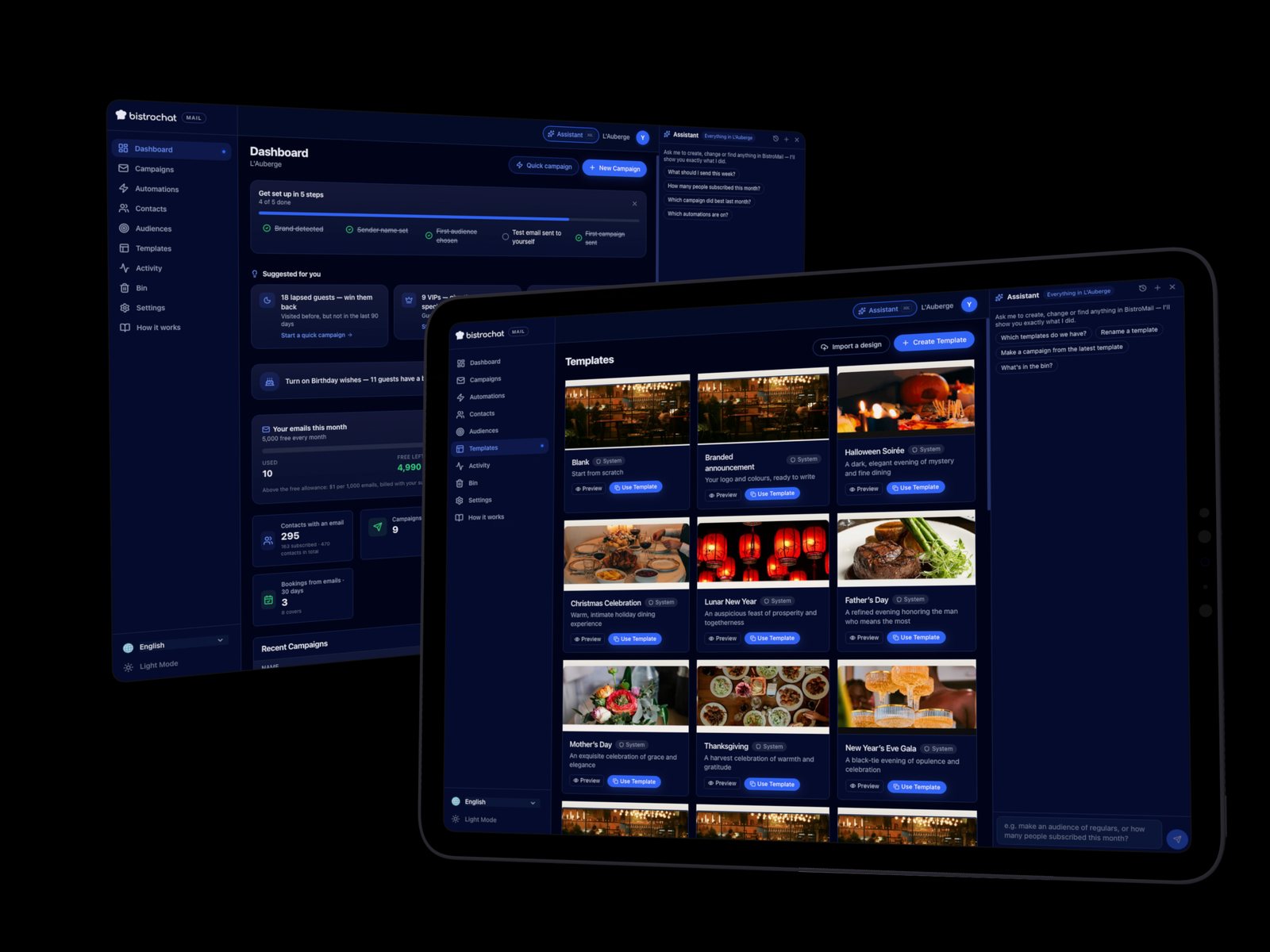
Several items on that list are things a reservation system either does for you or gets in the way of. Bistrochat sends automated post-visit review requests so review volume and recency stay steady rather than depending on someone remembering to ask. Bookings from Google Reserve, OpenRice, Dianping and the Michelin Guide land on the same live floor plan as your direct bookings, so being present on those platforms doesn't create a reconciliation problem. And because opening hours are set in one backend and served consistently to every channel, the hours a guest sees are the hours you actually keep — which is exactly the consistency AI systems are checking for.
None of that substitutes for good food. It removes the operational reasons a good restaurant stays invisible.
FAQ: AI search and restaurant recommendations
Does AI search replace Google for restaurant discovery? Not yet, but it's taking share. Google's local pack still surfaces far more restaurants than any AI assistant. The practical approach is treating AI visibility as an additional channel with its own rules, not a replacement for local SEO.
How long does it take to appear in AI recommendations? Live-retrieval improvements — profile accuracy, schema, listings — can show up within weeks. Getting into a model's trained-in knowledge takes far longer, since it depends on accumulated coverage across many sources and on future training cycles.
Can I pay to appear in ChatGPT or Gemini recommendations? No. There is no advertising placement inside these organic recommendations. This is why independent restaurants can compete with chains here more effectively than in paid search.
Do AI assistants know if my restaurant has closed or changed chef? Often not. Models trained on older data frequently recommend restaurants based on outdated information — one model we tested flagged this about its own answer. Keeping live listings accurate is how you correct the record.
Does having a booking widget on my site help AI visibility?
Indirectly but meaningfully. acceptsReservations is a schema field AI systems read, and a bookable restaurant is a better answer to "where can I book tonight" than one requiring a phone call.
Are AI recommendations different in different languages? Yes, substantially. Models trained mainly on English-language sources carry English-language media bias, so a restaurant celebrated in Cantonese or Thai coverage may be invisible in an English answer, and vice versa.
Should I write blog content to get recommended? Only if it genuinely answers questions diners ask. Content that gets cited tends to be structured — clear question, direct answer in the first sentence, short supporting facts — rather than promotional prose about your passion for hospitality.
What's the single highest-impact thing to do first? Check your review average against the thresholds. Everything else is wasted effort if you're filtered out before the comparison starts.
If your restaurant is doing everything right and still isn't showing up when diners ask an AI where to eat, get in touch — we'll walk through what's actually visible about you.