Running three restaurants shouldn't mean three logins
You open a second venue, then a third, and somewhere around venue two the cracks show up. A regular from your first restaurant walks into your new one and nobody recognises them. A guest calls your flagship on a fully booked Saturday and gets turned away, even though your sister venue two blocks over has three tables free all night. A group-wide push for Lunar New Year has to be built four separate times because each venue runs on its own disconnected setup.
None of that is a table management problem. It's a group management problem, and it's the reason multi-venue restaurant group management exists as its own category rather than "the same TMS, opened four times."
One booking page for the whole group
Instead of a booking page per restaurant, a group can run one group booking page that shows availability across every venue on a single screen. A guest who wants Saturday at 8pm sees which of your restaurants can actually seat them right now, instead of hitting a "fully booked" wall at the one they searched for.
That single screen does double duty as a cross-sell tool. A guest who came looking for your flagship can be offered your new opening, your sister concept, or your other brand in the same group — filling a quieter venue with demand your busiest one couldn't take, instead of losing that guest to a competitor because your flagship happened to be full.
Guests recognised wherever they book
When a guest books at any venue in your group, their profile travels with them: visit history, preferences, allergies, notes your team has added, special requests, and — with POS integration — what they ordered and spent, itemised.
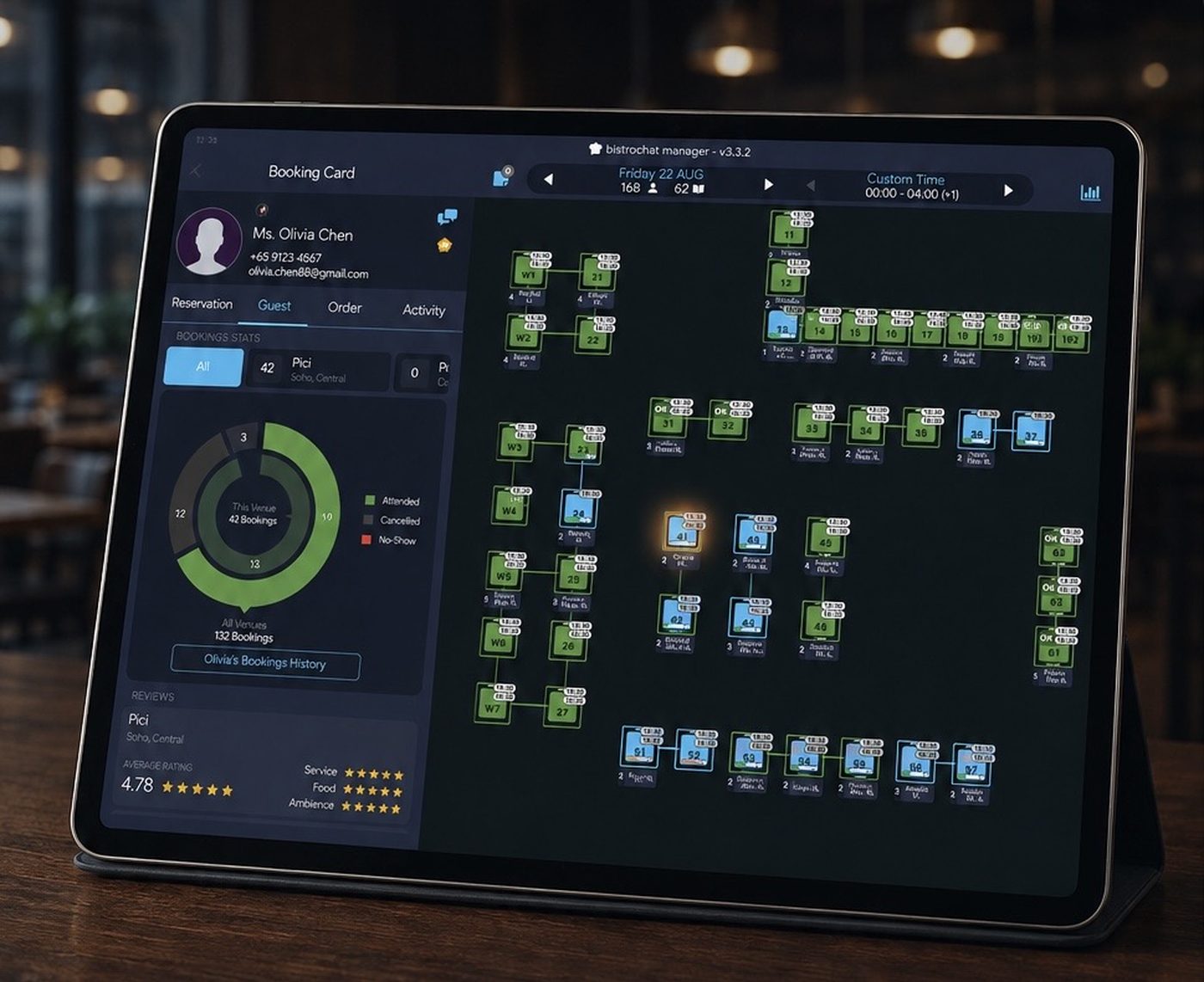
The regular who's been coming to your flagship for two years and tries your new opening for the first time isn't a stranger at the door. Your host sees the relationship already exists. A booking card shows both sides of that guest at once — their history at this specific venue, and their history across the whole group — so nobody has to ask "have you been here before?" when the honest answer is "not here, but everywhere else you own."
The numbers behind that relationship are visible at both levels too: lifetime spend at this venue and lifetime spend across the group, spend per visit, spend per cover, plus how many times this guest has booked, shown up, cancelled, or no-showed — at the venue and group-wide. A guest who's a reliable regular at one restaurant but a repeat no-show at another isn't invisible; that pattern shows up wherever they book next.
One CRM, plugged into your email marketing
The guest data isn't stuck inside Bistrochat either. The unified CRM connects to the email and marketing platforms groups actually run campaigns from — Mailchimp, Mailjet, Sendinblue, Brevo and others — with each guest tagged by which venue or venues they've visited.
That tagging is what makes group marketing actually usable instead of a blunt instrument. Send one newsletter to every guest across the group for a company-wide announcement, or split by venue and brand when a promotion only makes sense for one concept — a wine dinner at the fine-dining flagship shouldn't land in the inbox of someone who's only ever visited your casual noodle bar.
Each venue keeps its own identity
Centralised oversight doesn't mean centralised sameness. Every restaurant in the group operates independently inside the same account: its own floor plan, its own booking rules, its own service periods, its own booking widget design, its own guest communications.
A formal fine-dining flagship with long dining times and strict reconfirmation rules and a casual, walk-in-friendly sister concept can sit in the same group without either one bending to match the other. The group gets the operational visibility, and each venue keeps the personality that made it worth opening.
Reporting that rolls up without flattening
Each venue still gets its own full picture — bookings, guest and channel analysis, no-show and cancellation rates, and, where POS is connected, revenue, average bill, spend per cover and dish rankings. The group layer adds the ability to pull those per-venue reports from one place, or view the same metrics rolled up across the whole group, so a group manager isn't juggling separate logins just to compare how two locations are trending this month.
Track where every booking comes from, across the group
Marketing spend and affiliate partnerships rarely respect venue boundaries — a single campaign, influencer, or affiliate link is often meant to drive bookings to whichever venue in the group has room. Bistrochat tracks booking sources at the group level, so you can see which campaigns, affiliates and channels are actually generating covers across the whole portfolio, not just for one restaurant in isolation.
Built for how restaurant groups actually pay
Larger groups often run on enterprise payment infrastructure they can't just swap out because they adopted a new reservation system — centralised treasury, existing processor relationships, group-level reconciliation. Bistrochat's payment integrations, including enterprise processors like GlobalPayments, are built to sit inside that existing setup rather than force a group to restructure its finance stack around a booking tool.
And the pricing model that applies to a single venue applies across the group too: flat subscription, no per-cover fees, no booking commissions — so a group's costs stay predictable as it adds venues, instead of scaling with every additional cover across every additional restaurant.
Getting a group live
A single venue with a straightforward setup can be booking guests by the end of the day. A multi-venue group with more moving parts — several floor plans, different booking rules per concept, existing payment relationships to slot into — takes a bit longer, and Bistrochat's onboarding team sets a realistic timeline for that specific rollout rather than promising a one-size-fits-all launch date. Either way, it's a configuration project, not an IT project: no lengthy integration, no third-party consultants.
FAQ: multi-venue restaurant group management
Can I see a guest's lifetime spend at group level, not just per venue? Yes. Lifetime spend, spend per visit and spend per cover are visible both at the individual venue and rolled up across the whole group, alongside booking, no-show and cancellation history.
Can guests book any venue in the group from one page? Yes. A group booking page shows availability across every venue on one screen, so a guest can be offered another restaurant in the group when their first choice is full.
Do guests need to re-introduce themselves at each venue? No. Guest profiles — visit history, preferences, allergies, notes and spend — travel across every venue in the group.
Can we email guests through Mailchimp, Mailjet, Sendinblue or Brevo? Yes. The unified CRM syncs to those platforms, with guests tagged by venue so you can send group-wide campaigns or target a single brand or restaurant.
Can each restaurant keep its own branding and rules? Yes. Floor plan, booking rules, service periods, widget design and guest communications are all set per venue, independently.
Can we track which affiliates or campaigns are driving bookings group-wide? Yes. Booking source tracking works at the group level, so you can see which channels are generating covers across the whole portfolio, not just one venue.
Does adding venues change the pricing model? No. It's the same flat subscription structure per venue — no per-cover fees, no booking commissions, regardless of how many restaurants are in the group.
Can a large group keep its existing payment processor? Yes. Bistrochat's payment integrations are built to work within existing enterprise payment relationships, including processors like GlobalPayments.
How long does onboarding take for a multi-venue group? Longer than a single venue, because there's more to configure — but it's a realistic timeline built around your specific setup, not a lengthy IT rollout.
If you're running more than one restaurant and you're still logging in and out to manage them separately — get in touch — the reservation system built for a group, not just a venue.